Introduction
Artificial Intelligence (AI) is changing the way videos are created, edited, and published. From automatic subtitles and background removal to AI-generated clips and smart video effects, modern editing software can complete many tasks in just a few clicks.
This has led to an important question among students, creators, and aspiring professionals: Is AI replacing video editors?
The short answer is no. AI is changing the role of video editors rather than completely replacing them. While AI can automate repetitive editing tasks, human editors are still needed for storytelling, creative direction, visual decisions, pacing, emotion, and understanding the purpose of a video.
For students considering a Video Editing Course in Jodhpur, understanding this changing industry can help them prepare for the future and develop skills that work alongside AI rather than compete against it.
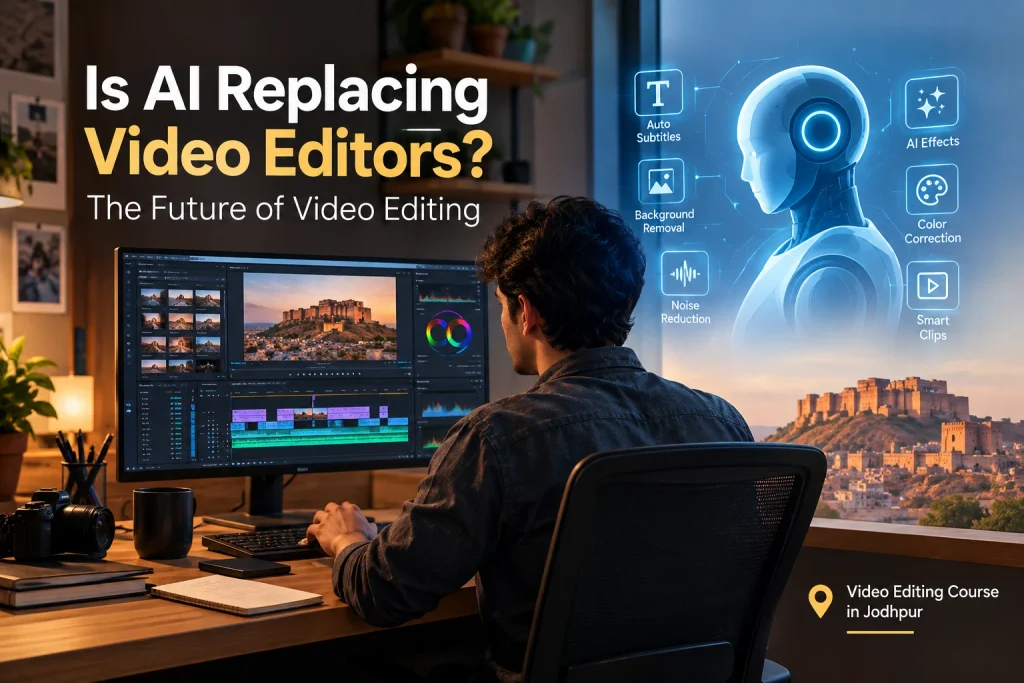
How Is AI Changing Video Editing?
AI-powered video editing tools are becoming increasingly common across the creative industry. They can automate several time-consuming processes that traditionally required manual work.
Some common AI video editing features include:
- Automatic video transcription
- AI-generated subtitles
- Background removal
- Noise reduction
- Automatic color correction
- Scene detection
- Object tracking
- Facial recognition
- Text-to-video generation
- AI voice generation
- Automatic video resizing
- Smart clip selection
- Generative visual effects
These tools can help editors save time and focus more on the creative aspects of a project.
For example, instead of manually creating subtitles for a 20-minute video, an AI-powered tool can generate a transcript and captions within minutes. The editor can then review and refine the result.
Can AI Completely Replace Video Editors?
AI can automate many technical tasks, but video editing involves much more than operating software.
A professional video editor needs to understand:
- Storytelling
- Visual composition
- Timing and pacing
- Music selection
- Audience psychology
- Brand identity
- Creative direction
- Emotional impact
- Cinematic techniques
- Client requirements
AI can suggest or automate certain decisions, but the final creative direction often requires human judgment.
Imagine a documentary about a person’s life. AI can identify scenes, create captions, improve audio, and organize footage. However, deciding which moment should appear first, where to create emotional pauses, and how the story should make viewers feel requires creative interpretation.
This is why human creativity remains an important part of professional video production.
AI vs Human Video Editors
AI and human editors have different strengths.
| AI Video Editing | Human Video Editing |
|---|---|
| Automates repetitive tasks | Develops creative concepts |
| Generates captions quickly | Understands storytelling |
| Removes backgrounds | Creates emotional impact |
| Speeds up workflow | Makes creative decisions |
| Detects scenes | Understands audience expectations |
| Provides automated effects | Builds visual identity |
| Processes large amounts of footage | Interprets client requirements |
The future of video editing is likely to involve AI-assisted editing, where editors use artificial intelligence as a productivity tool.
Why Human Creativity Still Matters
Video is a communication medium. A technically perfect video does not necessarily make a strong video.
A successful video needs a clear message and engaging presentation.
A professional editor may decide to:
- Cut a scene earlier to improve pacing
- Keep a reaction shot for emotional impact
- Change the music during an important moment
- Use a specific transition to establish a visual style
- Rearrange scenes to improve storytelling
- Adjust colors to match a brand
- Remove unnecessary footage
- Create a stronger opening hook
These decisions require context and creative thinking.
AI can assist with these processes, but an editor needs to understand why a particular editing choice works.
AI Is Creating New Opportunities for Video Editors
Rather than viewing AI only as a threat, aspiring editors can learn how to use it as part of their workflow.
An editor who knows traditional editing software as well as AI-powered tools can potentially complete projects more efficiently.
For example, an AI-assisted workflow could look like this:
Step 1: Import and organize footage
Step 2: Use AI transcription to identify important sections
Step 3: Generate an initial rough cut
Step 4: Edit the story and pacing manually
Step 5: Improve audio using AI tools
Step 6: Add motion graphics and visual effects
Step 7: Perform color correction and grading
Step 8: Review the final video manually
Step 9: Export different versions for social media platforms
This combination of technology and creativity can make the editing process faster without removing the editor from the creative process.
Why Learn Video Editing in the AI Era?
With the growth of YouTube, Instagram, short-form content, advertising, OTT platforms, online education, podcasts, and digital marketing, video continues to be an important communication format.
Businesses need videos for:
- Social media marketing
- Product promotions
- Advertisements
- Corporate communication
- YouTube channels
- Educational content
- Brand campaigns
- Event coverage
- Reels and short-form videos
- Online courses
This creates opportunities for people with practical video production and editing skills.
Students taking a Video Editing Course in Jodhpur can learn the fundamentals of editing while also developing skills that are relevant to modern digital content creation.
What Should You Learn in a Video Editing Course?
A modern video editing program should go beyond basic cutting and transitions.
Important areas to learn include:
1. Video Editing Fundamentals
Students should understand timelines, cuts, transitions, frame rates, resolutions, codecs, and video formats.
2. Professional Editing Software
Learning professional editing applications can help students understand industry-standard workflows.
Common areas include:
- Timeline editing
- Audio editing
- Color correction
- Effects
- Motion graphics
- Multicam editing
- Export settings
3. Storytelling
Storytelling is one of the most important skills for a video editor. Students should learn how to structure footage and create a clear visual narrative.
4. Motion Graphics
Motion graphics can make videos more engaging and are widely used in advertising, social media, corporate videos, and digital content.
5. Color Grading
Color can influence the mood and visual identity of a video. Understanding color correction and grading is therefore an important professional skill.
6. Sound Editing
Good visuals cannot compensate for poor audio. Students should learn dialogue cleanup, music placement, sound effects, mixing, and basic audio enhancement.
7. AI Video Editing Tools
Modern editors should also understand AI-powered editing features and generative tools.
The goal is not simply to let AI edit everything. The goal is to understand where AI can save time and where human creativity should take control.
Video Editing Career Opportunities
Learning video editing can lead to different career paths depending on an individual’s interests and skills.
Possible roles include:
- Video Editor
- Assistant Video Editor
- YouTube Video Editor
- Social Media Video Editor
- Motion Graphics Designer
- Content Creator
- Video Production Assistant
- Post-Production Artist
- Freelance Video Editor
- Short-Form Video Editor
Some professionals also combine video editing with graphic design, animation, digital marketing, or social media management.
This broader skill set can be particularly useful in today’s digital content industry.
Video Editing Jodhpur: Learning Skills for a Changing Industry
The demand for digital content is not limited to major metropolitan cities. Businesses, educational institutions, creators, agencies, and local brands increasingly use video to communicate with their audiences.
For students searching for Video Editing Jodhpur, learning in a structured environment can provide an opportunity to build practical skills while developing a professional portfolio.
A strong learning program should include practical projects rather than focusing only on software tutorials.
Students can practice creating:
- YouTube videos
- Instagram Reels
- Promotional videos
- Short films
- Product videos
- Event videos
- Educational videos
- Social media advertisements
- Corporate videos
Building a portfolio through such projects can help demonstrate practical editing abilities to potential clients or employers.
Will AI Create More Demand for Skilled Editors?
The video industry is evolving quickly, and AI is lowering the time required for many technical tasks.
As basic editing becomes easier, the value of higher-level creative skills may become more important.
Editors who understand storytelling, cinematography, motion graphics, sound design, color grading, branding, and AI-assisted workflows can develop a broader professional skill set.
Instead of competing directly with AI, future editors can learn to operate AI tools effectively.
The editor’s role may increasingly shift from simply “editing footage” to managing the creative process and using technology to produce better content faster.
How Students Can Prepare for the Future of Video Editing
Students interested in video editing can focus on five areas:
Learn the Fundamentals
Understand editing principles before depending on automated tools.
Build Creative Skills
Practice storytelling, composition, pacing, sound, and visual communication.
Learn AI Tools
Explore AI-assisted editing, transcription, audio enhancement, generative tools, and automated workflows.
Create a Portfolio
Work on real or self-created projects and maintain a portfolio that demonstrates different editing styles.
Keep Learning
Video technology changes quickly. Regularly learning new software, workflows, and production techniques can help editors stay adaptable.
Is Video Editing Still a Good Skill to Learn?
Video editing remains a valuable creative and technical skill, but the profession is changing.
The future editor may not spend every minute manually cutting clips, creating captions, or removing backgrounds. Instead, AI can handle some repetitive tasks while the editor focuses on storytelling, creative decisions, quality control, and communication.
For students looking for a Video Editing Course in Jodhpur, this makes it important to choose a learning path that combines traditional editing principles with modern AI-assisted workflows.
The most useful approach is not AI versus video editors. It is AI plus skilled video editors.
Frequently Asked Questions
Is AI replacing video editors?
AI is automating many repetitive video editing tasks, but human editors remain important for storytelling, creative decisions, visual style, and understanding client requirements.
Will video editing jobs disappear because of AI?
AI is changing video editing workflows, but video production still requires creative and technical professionals. Editors who learn AI-assisted tools can adapt to changing workflows.
Should I learn video editing in 2026?
Learning video editing can be useful for people interested in content creation, digital marketing, filmmaking, social media, advertising, and online video production.
What should I learn in a Video Editing Course in Jodhpur?
A comprehensive course can cover editing fundamentals, professional editing software, storytelling, motion graphics, color grading, sound editing, video formats, portfolio development, and AI-assisted editing workflows.
Can AI edit a complete video automatically?
AI tools can automate significant parts of the editing process, but human review and creative direction are still valuable for ensuring that the final video communicates the intended message.
Is Video Editing Jodhpur a suitable career option?
Video editing can be used across content creation, advertising, social media, education, entertainment, and digital marketing. Students can explore employment, freelance, and content-creation opportunities depending on their skills.
Conclusion
AI is transforming video editing, but transformation does not necessarily mean replacement.
Artificial intelligence can automate repetitive tasks, speed up workflows, and provide powerful creative assistance. Human editors continue to contribute storytelling, creativity, judgment, visual direction, and emotional understanding.
For anyone considering a Video Editing Course in Jodhpur, the future is less about choosing between AI and traditional editing and more about learning how both can work together.
The video editor of the future may be someone who understands editing fundamentals, creative storytelling, professional software, and AI-powered tools—using technology to work faster while keeping human creativity at the center of the final video.