Complete guide to NIFT study material 2027 — top NIFT books 2027, subject-wise NIFT preparation books, study plan, and expert tips to crack GAT & CAT confidently.
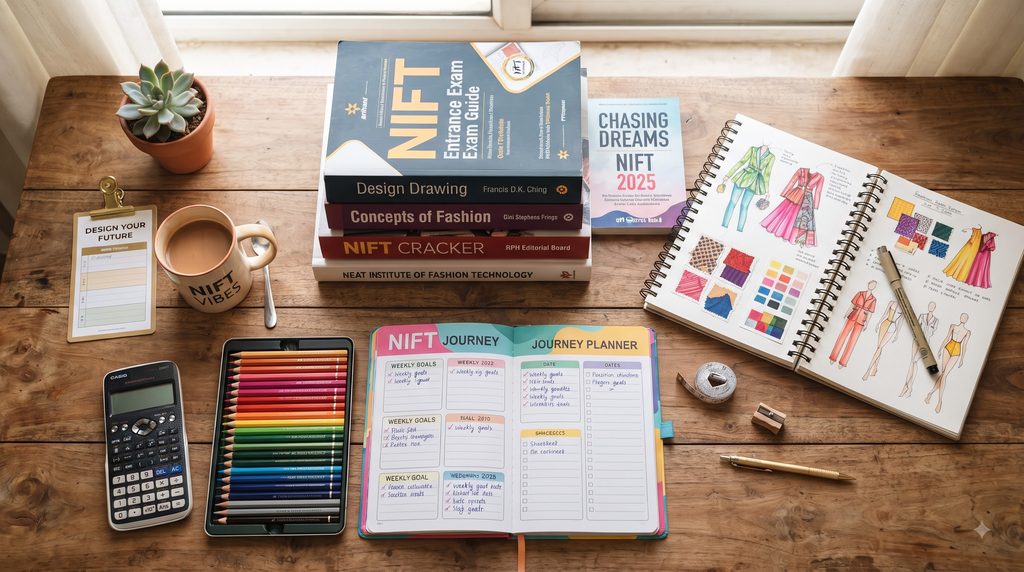
Every year, lakhs of design aspirants across India compete for a limited number of seats at the National Institute of Fashion Technology (NIFT). With such intense competition, success depends not just on natural creativity but on disciplined, well-structured preparation. Choosing the right NIFT study material 2027 is often the deciding factor between aspirants who prepare efficiently and those who struggle with scattered, unfocused study efforts.
This comprehensive guide walks you through everything you need to know—understanding the exam pattern, selecting the right NIFT books 2027, subject-wise preparation strategies, and building a study plan that balances analytical thinking with creative skill-building.
Understanding the NIFT Entrance Exam
Before selecting any study material, it’s essential to understand exactly what the NIFT entrance exam evaluates. The exam is designed to test both analytical reasoning and creative sensibility, making it fairly unique compared to other competitive exams.
General Ability Test (GAT)
The GAT is a written, objective-type test covering:
- Quantitative Ability – Number systems, percentages, ratios, algebra, mensuration, and data interpretation
- Communication Ability – English grammar, vocabulary, reading comprehension, and sentence correction
- Analytical and Logical Ability – Puzzles, seating arrangements, coding-decoding, and pattern-based reasoning
- General Knowledge and Current Affairs – Static GK along with fashion, design, and current events awareness
Creative Ability Test (CAT)
The CAT evaluates a candidate’s design thinking, observation skills, and visual expression through:
- Sketching and illustration based on given themes or objects
- Color theory and composition
- Conceptual problem-solving through visual storytelling
- Proportion, perspective, and spatial understanding
Situation Test / GD-PI
Shortlisted candidates for B.Des programs typically undergo a Situation Test, where they create a 3D model or craft using given materials, while M.Des aspirants go through a Group Discussion and Personal Interview round.
Understanding this structure early helps you choose study material that addresses each component adequately, rather than over-investing time in just one section.
Why Choosing the Right Study Material Matters
A common mistake among NIFT aspirants is collecting an overwhelming number of books and resources without a clear strategy. This often leads to fragmented preparation, where candidates cover topics superficially instead of building deep, exam-ready command over concepts.
The right NIFT preparation books should ideally offer:
- Alignment with the current, updated exam pattern
- Sufficient practice questions along with detailed solutions
- Comprehensive coverage of both GAT and CAT sections
- Clear conceptual explanations, not just answer keys
- Previous years’ question papers with analysis
Rather than accumulating multiple books for the same section, it’s far more effective to select 2-3 reliable resources per subject and study them thoroughly, supplementing with mock tests and previous papers.
Subject-Wise Breakdown of NIFT Study Material
1. Quantitative Aptitude and Numerical Ability
This section tests fundamental mathematical skills under time pressure. Effective study material should cover:
- Number systems and simplification
- Percentages, profit and loss, and ratios
- Time, speed, and distance problems
- Basic algebra and mensuration
- Data interpretation through graphs and tables
Since speed matters as much as accuracy, prioritize books that include shortcut techniques and timed practice sets rather than just theory-heavy explanations.
2. Communication Ability and English Comprehension
Strong language skills can significantly boost your GAT score. Look for resources covering:
- Vocabulary building through root words and synonyms/antonyms
- Grammar rules including tenses, prepositions, and sentence structure
- Reading comprehension passages with varying difficulty levels
- Sentence correction and para-jumble exercises
Supplementing your books with daily newspaper reading and editorial analysis can noticeably improve comprehension speed and vocabulary retention over time.
3. Analytical and Logical Ability
This section rewards structured thinking and pattern recognition. Useful preparation material typically includes:
- Puzzles and seating arrangement problems
- Coding-decoding exercises
- Series completion and pattern-based questions
- Logical deduction and syllogisms
Since these questions often have multiple valid approaches, practicing a variety of question styles helps you identify the fastest method for each problem type during the actual exam.
4. General Knowledge and Current Affairs
Unlike static subjects, this section requires ongoing, updated preparation rather than last-minute cramming. Good NIFT study material 2027 for this section should include:
- Static GK covering history, geography, and important facts
- Fashion and design industry trends and terminology
- National and international current affairs from the past 12 months
- Notable personalities, awards, and events relevant to the design field
Since outdated books can actively hurt your preparation here, always verify that any GK material is specifically updated for the 2027 exam cycle rather than reused from previous years.
5. Creative Ability Test (CAT) Preparation
The CAT section is often underprepared by aspirants who focus heavily on GAT. Effective preparation resources should cover:
- Fundamentals of color theory and composition
- Sketching techniques for objects, human figures, and abstract themes
- Perspective drawing and proportion
- Sample CAT papers with evaluated or model answers
Since this section is evaluated subjectively, studying how top-scoring sample sketches are structured—and understanding common evaluation criteria—can be just as valuable as raw sketching practice.
6. Previous Years’ Question Papers
Regardless of which books or courses you choose, solving previous years’ NIFT papers remains one of the most reliable ways to understand the exam’s actual difficulty level and question style. Aim to solve at least 5-10 years of papers under timed conditions, and thoroughly analyze your mistakes afterward rather than just checking answers.

Where to Find Reliable NIFT Study Material 2027
Aspirants typically rely on a combination of sources for comprehensive preparation:
- Published guidebooks from established test-prep publishers, specifically updated for the current exam year’s pattern
- Coaching institute material – Often well-structured and exam-focused, though ideally supplemented with independent practice
- Online courses and video lectures – Particularly useful for visual learners tackling CAT-related design concepts
- Mock test series – Essential for simulating real exam conditions and tracking progress over time
- NIFT’s official website – The most reliable source for the latest exam pattern, syllabus updates, and official sample papers
When purchasing NIFT books 2027, always check the publication date and edition details to ensure the content reflects the most recent exam pattern, since exam formats and question styles can evolve from year to year.
Building a Structured Study Plan
Having quality study material is only half the equation—how consistently and strategically you use it determines your actual results. Here’s a general framework you can adapt based on your exam timeline:
Phase 1: Diagnostic Assessment (Weeks 1-3)
Begin with a full-length mock test to honestly assess your current strengths and weaknesses across GAT and CAT sections. This baseline helps you allocate study time more effectively rather than spreading effort evenly across topics you may already be strong in.
Phase 2: Foundation Building (Weeks 4-11)
Work through core concepts systematically, section by section, using your chosen NIFT preparation books. Dedicate specific days to quantitative aptitude, verbal ability, reasoning, and GK, while maintaining consistent daily sketching practice for CAT preparation alongside this phase.
Phase 3: Practice and Speed Building (Weeks 12-17)
Shift focus toward timed practice sets and topic-wise tests. This phase is about building exam-day speed and accuracy rather than learning new concepts, so prioritize quality practice over passive reading.
Phase 4: Revision and Mock Tests (Final 3-4 Weeks)
Take multiple full-length mock tests under strict exam conditions, simulating actual timing and environment as closely as possible. Thoroughly review every mistake, revisit weak topics, and fine-tune your time allocation strategy across sections.
Ongoing CAT Practice
Since creative and sketching skills develop gradually rather than through last-minute cramming, maintain consistent daily or alternate-day sketching practice throughout your entire preparation timeline, not just during dedicated CAT study phases.
Common Mistakes to Avoid During Preparation
- Using outdated editions – Always confirm your books are updated for the current exam year, especially for GK and current affairs sections
- Neglecting the CAT section – Many aspirants over-focus on GAT preparation while underpreparing for creative ability, despite its significant weightage
- Skipping previous years’ papers – These remain one of the closest simulations of actual exam difficulty and question patterns
- Not analyzing mock test performance – Simply taking tests without reviewing mistakes limits meaningful improvement
- Last-minute GK cramming – Current affairs require consistent, ongoing reading rather than concentrated last-week revision
- Overloading on study material – Having too many books often leads to shallow coverage; focus on thoroughly mastering fewer, high-quality resources
Additional Tips for Effective NIFT Preparation
- Maintain a dedicated sketchbook for daily practice, treating it as a non-negotiable habit rather than an occasional activity
- Follow fashion, design, and lifestyle news regularly to strengthen both GK knowledge and creative design sensibility
- Join aspirant communities or study groups where previous years’ questions and exam experiences are actively discussed
- Practice strictly timed sessions to build genuine exam-day speed rather than relying on relaxed, untimed study
- Revisit formulas, grammar rules, and shortcut techniques periodically, since these are easy to forget without regular repetition
- Balance analytical and creative preparation daily rather than dedicating entire weeks exclusively to one section
Frequently Asked Questions
Q1. What is the best NIFT study material 2027 for beginners?
Beginners should start with foundational books covering basic concepts in quantitative aptitude, English, and reasoning, paired with a dedicated sketching practice book for CAT preparation, before moving to advanced practice sets.
Q2. Are NIFT books 2027 different from previous years’ editions?
Updated editions typically reflect the latest exam pattern, revised GK content, and recent current affairs, making them more relevant than older, unrevised editions.
Q3. How many NIFT preparation books should I use?
It’s generally more effective to thoroughly study 2-3 reliable books per section rather than collecting numerous resources that lead to shallow, scattered preparation.
Q4. Is coaching necessary, or can I prepare using only books?
Many students successfully prepare using self-study with quality books and mock tests, though coaching can provide structured guidance, especially for CAT preparation and doubt resolution.
Q5. How important are previous years’ question papers?
Extremely important—they offer the most accurate representation of question patterns, difficulty levels, and time management specific to NIFT’s exam style.
Final Thoughts
Cracking the NIFT entrance exam requires a thoughtful combination of the right NIFT study material 2027, consistent daily practice, and a well-structured study plan that balances analytical and creative preparation. Whether you’re relying on published NIFT books 2027, coaching resources, or online courses, success ultimately comes down to disciplined execution—regular mock tests, honest self-assessment, and steady improvement across both GAT and CAT sections. Start early, stay updated with the current exam pattern, and maintain balanced effort across all sections to maximize your chances of securing admission to NIFT.