Starting a business can be exciting, but the initial investment, operational challenges, and uncertainty can make it difficult for first-time entrepreneurs. This is one reason why franchise businesses have become an attractive option for people who want to start a business with an established business model.
A Low Investment Franchise in India can provide entrepreneurs with the opportunity to enter the market with comparatively lower startup costs while benefiting from an existing brand, business system, training, and operational support.
From education and digital services to food, beauty, fitness, and professional training, there are several franchise opportunities available across India. However, choosing the right franchise requires careful research, financial planning, and an understanding of local demand.
What Is a Low Investment Franchise?
A low investment franchise is a business opportunity that generally requires less capital than traditional franchise models. The exact investment depends on the industry, brand, location, infrastructure, franchise fee, equipment, staffing, and other operational requirements.
Unlike starting a business completely from scratch, a franchise allows an entrepreneur to operate under an established brand and follow a proven business structure.
Depending on the business model, a low-cost franchise may offer:
- Lower initial investment
- Established brand identity
- Training and onboarding
- Marketing support
- Operational guidance
- Standardised business processes
- Access to products or services
- Technology and business tools
However, “low investment” does not mean “no investment.” Entrepreneurs should consider the complete cost of setting up and operating the business before making a decision.
Why Consider a Franchise in India?
The Indian market offers opportunities across education, retail, food and beverage, technology, beauty, logistics, professional services, and other sectors.
A Franchise in India can be particularly appealing to entrepreneurs who want a structured approach to business ownership.
1. Established Business Model
One of the biggest advantages of franchising is access to an existing business model. Instead of developing every process independently, franchise owners generally follow the systems and guidelines provided by the franchisor.
2. Brand Recognition
Building a new brand can take considerable time and marketing effort. A recognised franchise brand may already have an established identity, which can help entrepreneurs introduce their business to the local market.
3. Training and Support
Many franchise companies provide initial training and ongoing operational assistance. Depending on the agreement, support may cover marketing, staff training, technology, sales, customer service, and business operations.
4. Marketing Assistance
Franchisors may provide promotional materials, digital marketing resources, campaign support, branding guidelines, and other marketing assistance.
As a result, entrepreneurs may have access to a more structured marketing system than they would have when launching an independent business.
Best Low Investment Franchise Ideas in India
There is no single franchise category that works for every entrepreneur. The right opportunity depends on investment capacity, location, target customers, skills, and market demand.
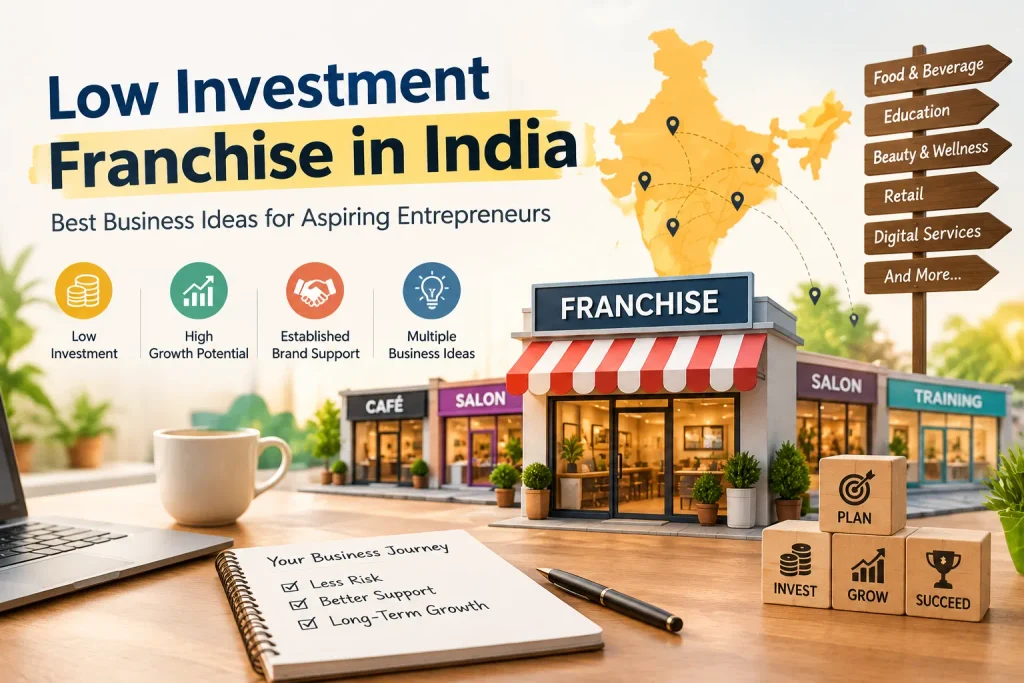
Here are some popular categories to explore when researching a Low Investment Franchise in India.
1. Education Franchise
Education is one of the major franchise sectors because students and professionals continuously look for skill development and career-focused learning.
An education franchise can include:
- Skill development institutes
- Design institutes
- Computer training centres
- Professional courses
- Coaching centres
- Vocational training
- Digital marketing institutes
- Creative skill academies
Education businesses can be particularly suitable for entrepreneurs interested in building a long-term local presence.
2. Design and Creative Skills Franchise
The demand for creative and digital skills has created opportunities in areas such as interior design, graphic design, fashion design, UI/UX, animation, and video editing.
A design education franchise can provide training programs for students who want to develop industry-relevant skills.
For entrepreneurs, this model can combine education with a growing demand for professional and creative courses.
3. Digital Marketing Franchise
Businesses across India increasingly depend on online visibility, social media, search engine optimisation, paid advertising, websites, and digital communication.
Therefore, a digital marketing franchise can be an option for entrepreneurs interested in the technology and marketing sector.
Services may include:
- SEO
- Social media marketing
- Google Ads
- Content marketing
- Website development
- Email marketing
- Online reputation management
4. Food and Beverage Franchise
Food and beverage businesses remain a popular category in the Indian franchise market. Depending on the concept, entrepreneurs can explore cafés, quick-service food outlets, beverage kiosks, dessert businesses, and other formats.
However, food businesses can involve expenses such as rent, kitchen equipment, staff, inventory, utilities, licenses, and marketing. Therefore, entrepreneurs should carefully calculate the total setup cost rather than looking only at the franchise fee.
5. Beauty and Salon Franchise
Beauty and personal care services are another category that can work in residential areas, commercial locations, and developing cities.
A salon franchise may provide:
- Established branding
- Staff training
- Product support
- Interior guidelines
- Marketing assistance
- Standard operating procedures
The investment can vary considerably depending on the salon format and location.
6. Fitness and Wellness Franchise
Gyms, yoga studios, fitness centres, and wellness services have created another franchise category for entrepreneurs.
A smaller-format fitness business may require less space than a large gym. However, equipment, rent, staff, maintenance, and customer acquisition should still be included in the business plan.
7. Courier and Logistics Franchise
The expansion of e-commerce and online shopping has increased the importance of delivery and logistics services.
Courier and logistics franchise models can provide services such as parcel collection, delivery, shipping, and local logistics support.
This category can be worth exploring in areas with growing residential and commercial activity.
8. Laundry and Cleaning Services Franchise
Professional laundry, dry cleaning, home cleaning, and commercial cleaning services can offer business opportunities in urban and developing markets.
A franchise model may provide standard operating procedures, equipment guidance, branding, and marketing support.
9. Computer and Technology Training Franchise
Technology skills are increasingly important for students, job seekers, and working professionals.
A computer training franchise can offer courses in:
- Basic computer skills
- Programming
- Web development
- Graphic design
- Data analytics
- Artificial intelligence
- Office productivity tools
- Digital skills
The specific course portfolio should be aligned with local demand and changing industry requirements.
10. Retail Franchise
Retail franchises cover a wide range of products and business formats. Depending on the brand, entrepreneurs may explore grocery, apparel, stationery, lifestyle products, or specialised retail concepts.
Location, customer demographics, inventory management, and competition are particularly important factors in retail.
How Much Does a Low Investment Franchise Cost in India?
The investment required for a Low Investment Franchise in India varies significantly from one business model to another.
Some of the major costs may include:
| Investment Area | What It May Include |
|---|---|
| Franchise Fee | Brand and franchise rights |
| Infrastructure | Interiors, furniture, equipment |
| Technology | Computers, software, POS systems |
| Inventory | Initial products or materials |
| Staff | Recruitment and training |
| Marketing | Launch and promotional activities |
| Rent | Commercial space and security deposit |
| Working Capital | Day-to-day operational expenses |
Therefore, entrepreneurs should calculate the total startup investment instead of comparing franchise opportunities only on the basis of the franchise fee.
How to Choose the Right Franchise in India
Choosing a Franchise in India requires more than finding an opportunity with a low entry cost.
Check the Total Investment
First, understand the complete financial requirement. Ask about franchise fees, interiors, equipment, technology, marketing, staff, rent, working capital, and recurring payments.
Research Market Demand
A business can perform differently in different locations. Study the local customer base, competition, purchasing behaviour, and demand for the product or service.
Understand the Franchise Agreement
Read the franchise agreement carefully before making a financial commitment. Pay attention to the duration, renewal terms, territory, fees, responsibilities, branding rules, and exit conditions.
Evaluate Training and Support
Find out what kind of support the franchisor provides before and after launch.
Ask questions such as:
- Is initial training provided?
- Is marketing support available?
- Is staff training included?
- What technology is provided?
- Is operational guidance available?
- How frequently is ongoing support provided?
Study the Business Model
Understand how the franchise generates revenue and what its major operating expenses are.
A low entry investment does not automatically mean low operating costs. Therefore, review the complete business model before investing.
Low Investment Franchise for Tier 2 and Tier 3 Cities
Franchise businesses are not limited to major metropolitan cities. Entrepreneurs in Tier 2 and Tier 3 cities can also explore franchise opportunities based on local demand.
Cities with growing populations, educational institutions, commercial development, and improving consumer spending can create opportunities for businesses in areas such as education, food, digital services, beauty, fitness, and professional training.
However, location selection remains important. A franchise should be placed where its target customers can easily access the business.
Franchise vs Starting an Independent Business
Both models have their own advantages and challenges.
| Factor | Franchise Business | Independent Business |
|---|---|---|
| Brand | Existing brand identity | Build from scratch |
| Business Model | Established framework | Develop independently |
| Training | Often available | Self-developed |
| Marketing | Possible brand support | Owner-managed |
| Flexibility | Franchise guidelines apply | Greater flexibility |
| Investment | Depends on franchise | Depends on business |
| Support | Franchisor support may be available | Owner handles operations |
The right choice depends on the entrepreneur’s goals, experience, budget, and preferred level of independence.
Common Mistakes to Avoid
Before investing in a Low Investment Franchise in India, avoid making decisions based only on attractive advertisements or promises.
Some common mistakes include:
- Focusing only on the franchise fee
- Ignoring working capital requirements
- Not researching local competition
- Choosing a business without understanding the industry
- Not reading the franchise agreement
- Underestimating marketing expenses
- Ignoring staff requirements
- Assuming guaranteed returns
- Not conducting proper due diligence
Instead, compare opportunities based on the complete business model, support system, costs, market demand, and responsibilities of both parties.
Steps to Start a Franchise in India
Starting a franchise can be approached through a structured process.
Step 1: Define Your Budget
Determine how much capital you can realistically allocate to the business.
Step 2: Select an Industry
Choose an industry that matches your interests, experience, local market, and investment capacity.
Step 3: Research Franchise Brands
Compare different franchise companies based on their business model, support, investment requirements, reputation, and terms.
Step 4: Study the Location
Analyse customer demographics, competition, accessibility, rent, and market potential.
Step 5: Review the Agreement
Understand the commercial and operational terms before signing.
Step 6: Prepare the Business Setup
Complete the required infrastructure, technology, recruitment, training, branding, and other setup activities.
Step 7: Launch and Market the Business
Once the centre or outlet is ready, implement a local marketing strategy and begin customer acquisition.
Frequently Asked Questions
What is a Low Investment Franchise in India?
A low investment franchise is a franchise business model designed to require comparatively lower startup capital than larger franchise formats. Investment varies by industry, brand, location, and business structure.
Which franchise is best for a low budget?
There is no universal option that is suitable for every entrepreneur. Education, digital services, professional training, and selected service-based businesses can have different investment requirements depending on their format.
Is a franchise better than starting a business independently?
A franchise generally offers an established business framework and brand support, while an independent business provides greater control over branding and operations. The suitable model depends on the entrepreneur’s goals and circumstances.
Can I start a franchise in a small city?
Yes. Many franchise categories can be considered for smaller cities when there is sufficient local demand. Education, food, beauty, digital services, and professional training are examples of sectors entrepreneurs may research.
What should I check before investing in a franchise?
Review the total investment, franchise agreement, recurring fees, support system, market demand, competition, location requirements, operating costs, and expected responsibilities.